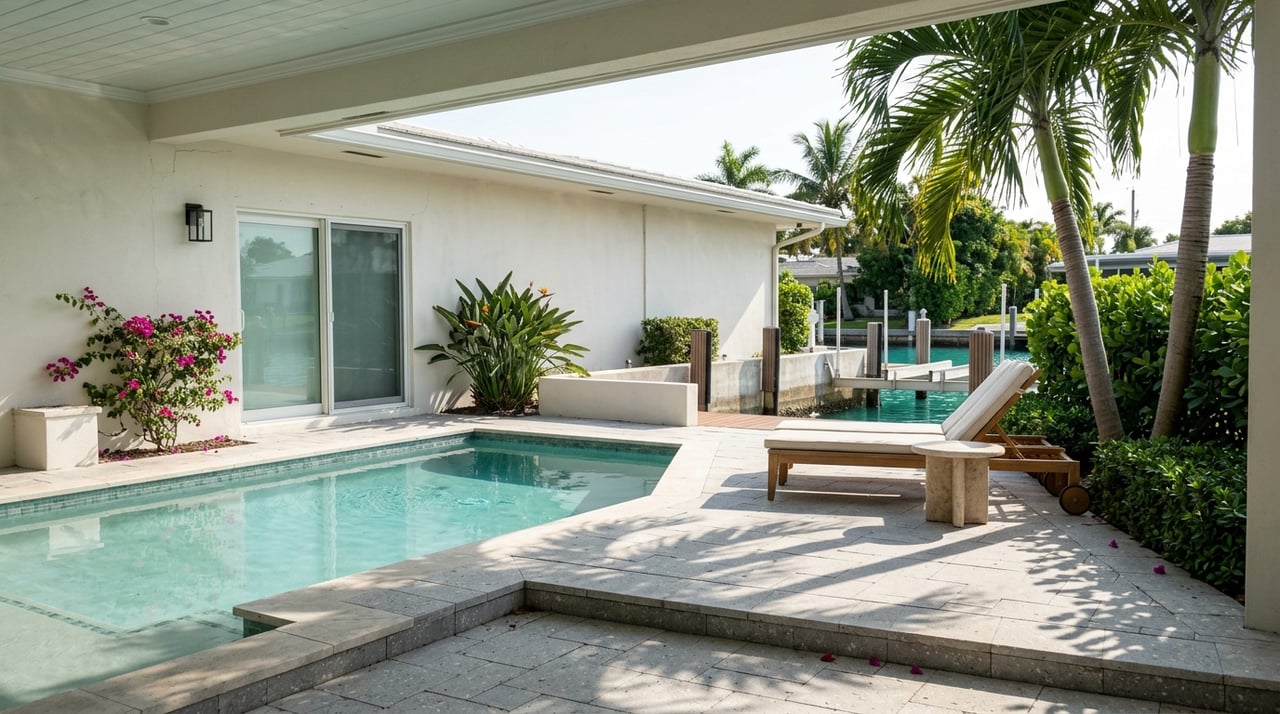
Should You Renovate or Tear Down a Boca Raton Waterfront Home?
Wondering whether a Boca Raton waterfront property is a candidate for a polished renovation or a full tear-down? In this market, that decision is rarely about taste alone. It comes down to land value, the condition and value of the existing structure, and the flood and coastal rules that may apply if you improve or rebuild. If you own, are buying, or are evaluating a waterfront home in Boca, this guide will help you frame the decision more clearly. Let’s dive in.
In Boca Raton, waterfront pricing can vary sharply from one area to the next. Citywide figures can give you broad context, but they are often too general for a canal-front, Intracoastal, or ocean-adjacent property where location and rebuild potential drive value.
Current market data points to a mature, balanced market rather than a pure bidding-war environment. Realtor.com reports a median listing price of $579,624, a 95% sale-to-list ratio, and 67 median days on market, while Redfin reports a median sale price of $815,000 and 79 days on market. For waterfront owners, the bigger takeaway is not the citywide average. It is that pricing must be tied to the exact corridor, water access type, and development upside.
That becomes even more important in Boca’s higher-priced pockets. Realtor.com shows Southeast Boca Raton at $1.595 million and Downtown Boca Raton at $1.69 million, well above the broader city figures. On a waterfront lot, a meaningful part of value may sit in the land itself, not just in the existing house.
Before you ask whether you can renovate, it helps to ask whether the current structure still earns its place on the lot. Palm Beach County’s residential appraisal guidance points to two core concepts in valuation: comparable sales and the cost to replace improvements.
That matters because assessed value and market value are not the same thing. If you are weighing a renovation against redevelopment, the key question is usually current market value, not just what appears on a tax bill.
For a waterfront property, this often means looking at:
If the land is doing most of the heavy lifting, a tear-down may deserve serious consideration. If the existing house still contributes meaningful value and can be upgraded efficiently, renovation may be the smarter play.
Two Boca waterfront homes can look similar on paper and produce very different outcomes once you review flood exposure, permit history, and site constraints. That is why parcel-level diligence matters far more than relying on broad market summaries.
Palm Beach County has already updated flood maps effective December 20, 2024. According to the county, thousands of eastern-county residents were added to high-risk flood zones, more than 16,000 parcels will see base flood elevations rise by one foot or more, and all county residents live in a flood zone. The county also notes that windstorm insurance does not cover flood damage.
For Boca waterfront owners, that change can alter renovation math quickly. A home that once looked like a straightforward remodel may face more demanding elevation or design requirements depending on the scope of work.
Renovation tends to make more sense when the existing structure is still fundamentally workable and the project scope stays controlled. In practical terms, that usually means you are improving a house that already fits the site reasonably well rather than trying to force a completely new program into an old shell.
A renovation may be the better option when:
One of the biggest factors is the substantial-improvement threshold. FEMA defines substantial improvement as work costing 50% or more of the structure’s market value before construction starts. In Florida flood hazard areas, once a project crosses that line, repairs, additions, or alterations must comply with new-construction flood design requirements.
That can change the economics of a remodel fast. What begins as an upgrade can turn into a much more expensive code-driven project if the scope pushes too far.
A tear-down or full redevelopment often makes more sense when the structure is outdated, functionally limited, or likely to trigger major compliance costs anyway. In those cases, layering expensive work onto an older building can be less efficient than starting fresh.
A rebuild may be worth serious attention when:
This is especially relevant on premium waterfront parcels where the future value may be driven by a new-construction outcome. If your intended end product includes a different layout, a major exterior redesign, or substantial site work, a clean-sheet approach can sometimes be easier to price and plan.
In Boca Raton, permits are required to construct, enlarge, alter, repair, move, demolish, or change the use and occupancy of a building or structure. That means both renovation and tear-down scenarios need to be evaluated with permitting in mind from the start.
The city’s one- and two-family permit checklist includes separate residential scopes such as full demolition, dock, seawall, boatlift, and new single-family detached construction. That separation matters because waterfront work is rarely just about the house. Site improvements can become their own permitting track.
If you are considering demolition, Boca’s checklist is detailed. It calls for multiple forms and supporting documents, including a contract, adjacent-owner notification letter, utility disconnect letters, refrigerant recovery affidavit, recorded warranty deed, survey or site plan, and, in some cases, a certified Notice of Commencement.
The city also uses eHub for permit applications, fee payments, inspections, and public-record searches. Boca’s permit-history system is especially useful during diligence because it can help you verify whether prior additions, roofs, docks, or other improvements were properly permitted.
On waterfront property, flood compliance is often the pivot point. A renovation that looks reasonable from a design standpoint may become much less attractive if the cost of required upgrades rises sharply.
Florida’s flood provisions state that in flood hazard areas, repairs, additions, or alterations that qualify as substantial improvement must meet new-construction flood design requirements. For structures seaward of the coastal construction line, the code also requires resistance to the predicted forces of a 100-year storm event.
This is why owners should avoid treating flood review as a box to check later. In Boca, especially on eastern and coastal parcels, flood and storm design requirements can drive budget, timeline, and feasibility.
A practical rule of thumb is simple: if renovation cost plus likely flood and code upgrades starts approaching the market value of the structure, a tear-down should be evaluated seriously. If the work stays comfortably below that threshold and the house already supports your goals, renovation can preserve time and carrying-cost efficiency.
Not every Boca waterfront property faces the same coastal review, but oceanfront and nearshore sites need extra care. Florida’s Coastal Construction Control Line program regulates structures and activities that could affect erosion, dunes, upland properties, or public access in the coastal zone.
Boca Raton also maintains more than 4.75 miles of shoreline through beach nourishment, dune management, inlet dredging, and land preservation. For owners of beachfront or shoreline-adjacent property, that reinforces the need to understand site-specific coastal conditions before finalizing a renovation or redevelopment plan.
If the property is oceanfront or near the shoreline, a fresh design may sometimes be easier to evaluate than trying to adapt an older envelope to current coastal standards. That does not mean redevelopment is always better. It means the underwriting needs to be disciplined.
Some properties face another layer of review. In Boca Raton, properties in Old Floresta, Pearl City, or an individual historic site may require a Certificate of Appropriateness for exterior construction, rehabilitation, maintenance or repair, or demolition.
If a property falls into one of those categories, demolition or major exterior changes can become more document-heavy and slower to move through approvals. That is why historic status should be part of the first review, not a late discovery after design money has already been spent.
If you are deciding between renovating and rebuilding, the cleanest way to frame it is to test the property against a few core questions.
On premium Boca waterfront, the lot may be the scarce asset. If the land value is carrying most of the investment case, the existing structure may deserve a hard look.
If the shell, elevation, layout, and waterfront infrastructure are still useful, renovation may preserve value efficiently. If the home needs major structural, flood, or site changes, redevelopment may be more rational.
The substantial-improvement threshold is not a minor detail. Once crossed, the project may need to meet standards closer to new construction.
Official permit records can reveal whether prior work was properly approved. Unpermitted additions or site work can add cost and uncertainty to a renovation.
Beachfront, nearshore, and historically designated properties can carry extra review requirements. Those constraints should be priced in early.
Before moving forward, make sure your review includes the basics that can materially affect the decision:
Palm Beach County specifically advises confirming flood information with a Florida-licensed engineer, architect, or surveyor before purchase or construction. That kind of parcel-specific verification is what turns a broad idea into a sound decision.
In Boca Raton, the right question is usually not just whether you should renovate or tear down. It is whether the existing improvement still makes financial and practical sense once you fully price in flood compliance, permit history, shoreline rules, and replacement cost.
On one block, a thoughtful renovation may preserve value and reduce complexity. On another, the land may be the real opportunity and a rebuild may be the cleaner long-term answer. That is why disciplined valuation and property-level diligence matter so much in Boca’s waterfront market.
If you are evaluating a Boca waterfront property and want a finance-first view of the numbers, strategy, and resale implications, Illustrated Properties Palm Beach can help you assess the opportunity with discretion and local market insight.
Stay up to date on the latest real estate trends.

Ready to transform your real estate experience? Contact Thomas now to discover how he can guide you with personalized service, exceptional results, and unmatched expertise. Let's achieve your goals together!