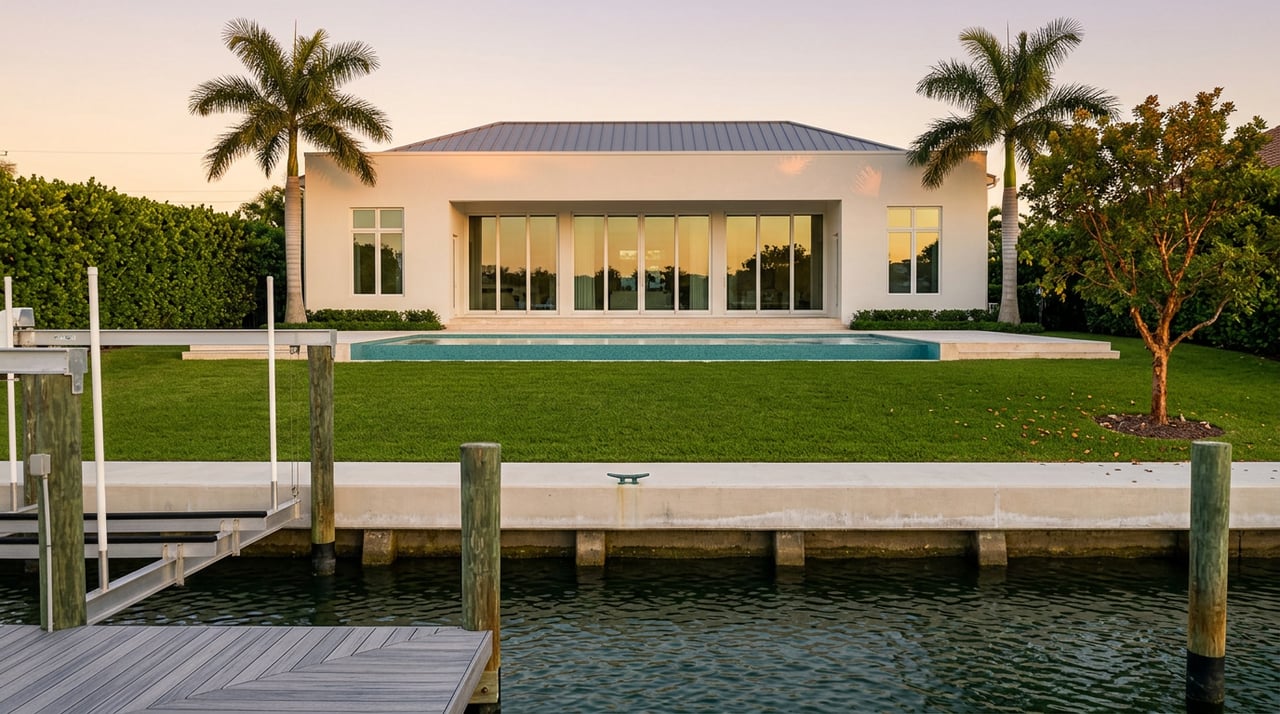
How Land Value Shapes Jupiter Waterfront New Construction
A few miles south of Jupiter, in a private oceanfront enclave in North Palm Beach called Lost Tree Village, a house just sold for $27.5 million. It has four bedrooms, 6,800 square feet, and was built in 1992. The buyer has no plans to live in it. The plan is to knock it down.
That sale is a regional example of how waterfront buyers can value land more than an existing structure. Above $4,000 per square foot for a structure headed for the wrecking ball, the number never had anything to do with the house. It reflected one acre of direct ocean frontage that the previous owner bought for $2.5 million back in 1991. The buyer is not purchasing 6,800 square feet of living space. They are purchasing 128 feet of Atlantic shoreline and paying a premium to remove the obstacle sitting on top of it.
In Jupiter, the distinction between a waterfront home's structure and its land value matters when comparing listings that look similar on paper.
Jupiter has almost no vacant waterfront land left to build on. Outside of a handful of interior parcels, a buyer who wants a brand-new home on the water is not choosing between an empty lot and an existing house. They are choosing which existing house to remove.
Local builders describe the split plainly: some homeowners pursue luxury renovations, and others choose teardown-and-rebuild projects from the start, according to Steve Cury Construction, a firm that works across Jupiter's waterfront communities. Turtle Beach Construction, a design-build firm operating in Jupiter, Jupiter Island, Tequesta, and Palm Beach since 1985, has built its business almost entirely around that second path: ultra-luxury waterfront estates constructed on sites that used to have something else on them.
This is worth sitting with, because it means the phrase "new construction" on a Jupiter waterfront listing rarely describes untouched ground. It describes a transaction that already happened once, quietly, before the listing you are looking at ever went live.
Admirals Cove is the community where this shows up most clearly in the data. Developed in 1986 across 976 acres with 891 homes, it remains one of northern Palm Beach County's most active waterfront markets, with several miles of protected, navigable canal frontage able to handle vessels up to 130 feet.
Over the trailing 12 months ending in August 2026, 50 homes changed hands in Admirals Cove. The average asking price was $8,372,836 against an average selling price of $7,595,868, a list-to-sell ratio of 91 percent, and an average of $1,266 per square foot. Homes took an average of 101 days to sell.
Treat that $1,266 figure as a single market signal and you will misread it. It blends two products that share a zip code and not much else. One is a renovated, move-in-ready home where the price reflects finishes, systems, and layout. The other is a lot where the existing structure is a placeholder, and the number on the listing is really a bid on dirt, frontage, and dock rights.
Two current examples make the split concrete. At 369 Eagle Drive in Admirals Cove, a $23 million new-construction estate was marketed on 115 feet of waterfrontage with a second-quarter 2026 completion target, seven bedrooms, and seven full and two half baths. A few streets over, 372 Regatta Drive is marketed at $32 million, and the listing leads with its 115 feet of frontage and unobstructed water views before it says anything about the house. In both cases, the frontage footage is doing the selling. The structure is a supporting detail.
| Renovated resale | Land-value listing | |
|---|---|---|
| What drives the price | Finishes, layout, systems | Frontage feet, water depth, dock rights |
| What the listing photos emphasize | Interior spaces | Water views, lot lines, sunset exposure |
| What $1,266/sqft actually measures | Livable space | The parcel underneath it |
If you are comparing two Jupiter waterfront listings using price per square foot alone, you are treating those two rows as one.
There is a second layer to the land-value calculation that rarely shows up until an offer is already on the table. Most Jupiter waterfront homes offer private docks with direct ocean access and no fixed bridges standing between the dock and the inlet. Some homes along the Loxahatchee riverfront, however, sit behind fixed bridges with height restrictions that cap the size of vessel that can pass underneath.
Two lots with identical frontage, identical square footage, and identical asking prices can carry very different land values once that detail surfaces, because a fixed bridge does not just limit the current owner's boat. It limits every future buyer's boat, permanently, regardless of what gets built on the lot. For a buyer paying primarily for the land rather than the house, that single fact can matter more than the number of bedrooms.
This is the kind of detail that separates a listing sheet from an actual valuation, and it is why the address at 5211 Pennock Point, positioned on one of the Loxahatchee River's few coveted points, is marketed almost entirely on its location rather than its floor plan. The point lot itself is described as a legacy address. The house is incidental to why the address commands attention.
For a buyer or investor working through Jupiter's waterfront inventory with a teardown or near-teardown purchase in mind, a few questions matter more than the ones a typical listing answers:
None of this is a reason to avoid Jupiter's waterfront market. It is a reason to price it correctly. A buyer who understands that the structure on a $20 million listing may carry zero value, or negative value once demolition is priced in, is negotiating from a stronger position than one who is still comparing bedroom counts.
The Lost Tree Village sale in North Palm Beach is not an isolated data point. It is part of a wider pattern of scarce waterfront land setting records up and down this stretch of coast, from Manalapan through Jupiter, where the same demand for irreplaceable frontage keeps pushing land value further ahead of structure value. Jupiter's version of this story is playing out right now in Admirals Cove and along the Loxahatchee, on lots where the house is a placeholder and the address is the asset.
For buyers weighing Jupiter against neighboring waterfront markets, that is the number worth holding onto. Not the median price. Not even the price per square foot. The question underneath both: what happens to this figure once you separate what the land is worth from what the house on it will cost you to remove.
If you are evaluating a specific Jupiter waterfront property, or comparing what your budget actually buys across Admirals Cove, the Loxahatchee, and neighboring Palm Beach County waterfront communities, Illustrated Holmes can walk through the land-value math on a specific address. Schedule a private consultation to start that conversation.
If a house on a waterfront lot is in good condition, does that mean it isn't a teardown candidate? Not necessarily. Condition matters far less than lot value once frontage, depth, and dock rights exceed what the existing structure could ever justify on its own. A well-kept home on a scarce point lot can still be purchased for demolition if the land underneath it is worth more without it.
Does a lower price per square foot ever signal a genuine bargain in this market? Sometimes, but only after separating the land component from the structure component. A lower blended number can mean an older, functional home priced fairly for what it is, or it can mean a land-value listing where the market has not yet caught up to comparable frontage sales. The two look identical on a spreadsheet and require different offers.
Stay up to date on the latest real estate trends.
Ready to transform your real estate experience? Contact Thomas now to discover how he can guide you with personalized service, exceptional results, and unmatched expertise. Let's achieve your goals together!